Here are some photo's showing one way to build a rudder quickly and easily. The quick overview is cut out the shape in a thin material, tape the sides together, insert the rudder shaft, fill the inside of the rudder with epoxy. This takes about 10 min or so to do. Followed by installation in your boat.
John Fisher
Lay out the rudder shape on a sheet of 1/64 ply. On other class boats John used a single layer of a 6 oz carbon fiber layup, so you could also lay up some fiberglass for use on the star. To do a glass layup, just take a sheet of 6 oz or heavier fiberglass, a sheet of lexan or plexiglass, and some resin. The first step is to spread resin on the plexiglass, then apply the fiberglass and then make sure it is all wetted out. Once cure flex the plexiglass and the layup will pop off.
Shows the two sides cut out of plywood, these could be fiberglass instead. Straight sided shapes like shown and the star plans are easier to make.
Tape the two sides together with masking tape. With curved shapes He taped them together then insert the shaft and resin. If you use straight sides on the rudder you can tape one side and then open it up like a book, apply resin, then close and tape shut. The open book method uses less resin but only works with sq or straight sided shapes.
Note the bend John put in the shaft to prevent it from turning inside the rudder.
Shows the top open to pour in resin. John uses a syringe to pour in resin once the shaft is in place. You can add micro balloons to the resin if concerned about weight.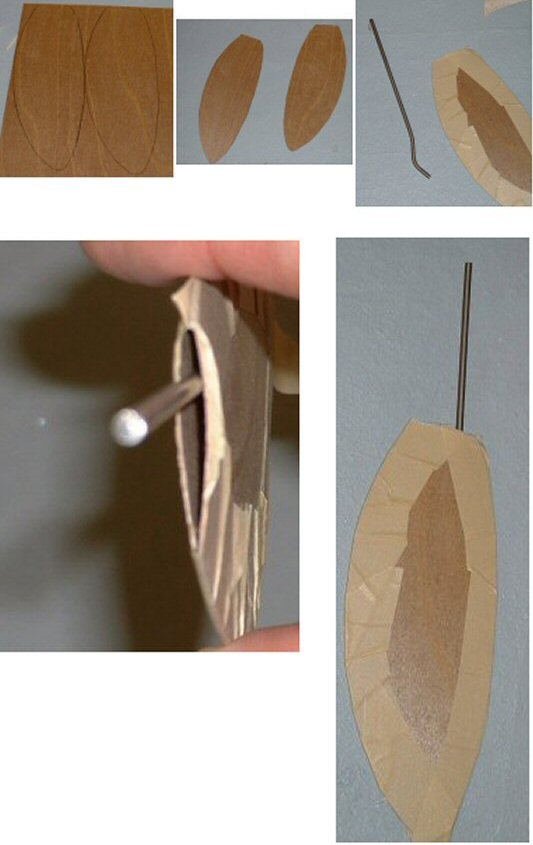
Installing Rudder in Star 45


5/03/2011
Sailing Model, AMYA Star45 Class | building rudder

downloadable files for cutting laser shadows (aka, frames, bulkheads)
You can use your browser, go to www.mainzone.com/star45frames/ select the files you want and they will download to your machine. BTW, only the single stringer files are available from Mainzone.com/.
--
John Fisher provided the CAD files for laser cutting frames. These frames are trimmed based on 1/16 thick planking.
Contact John Fisher to obtain custom DXF and PDF files and to report any issues with the files. email John racer577 at citystar.com (remove the space between 7 and at, change at to @, and remove the space between at and citystar)
--
Most laser plotters used to cut materials require either DXF files or DWG files
DXF files are CAD vector data - plotter files that instruct a device to "start here" then put the (pen, knife) down and "move to, go to"...
Select dxf or dwg based the file type used by your laser cutter.
A CAD viewer or CAD application is required to view the contents. When you download some file types you may see "words" not pictures since these are files with machine commands.
5/02/2011
John Fisher - Dave Mainwaring Award
Monday, June 23, 2008
Star45 : John Fisher - Dave Mainwaring Award
Star45 : Message: John Fisher - Dave Mainwaring Award:
"I have received a wooden plaque with a half model of a Star 45 and several brass plates on it from Robert Fisher. Here is what he wrote along with the plaque:
Deed of Gift
John Fisher - Dave Mainwaring Award
The purpose of this award is to recognize the efforts of John Fisher and Dave Mainwaring to utilize 21st Century computer technology to support and facilitate the scratch building for the Star 45 Class, and to regonoize the best builder-sailor at the Star 45 National Championship Regatta. Only people who scratch - built the Star 45 they sail in the National Championship Regatta may compete for this trophy. Any person who did not personally scratch - build the boat they sail is not eligible for this award. The trophy is to be awarded, until the next National Championship, to the eligible person who has the best finish in the Star 45 National Championship. This award shall not be retired.
This award is in addition to the Julie Ayers award!
Don Keeney
Star 45
Class Secretary"
4/25/2011
Rosette Gault articles on paperclay to download
The Helpful Practical Basics
"how-to" get started with pictures PDF's
==
Rosette Gault Bio:
Rosette Gault, M.F.A Ceramics, has been contributing to
the field of artistic ceramics as a visual artist for over 35 years.
Her award winning ceramic sculpture and commission work has been
exhibited widely since 1978, and is included in public and private
collections in Canada, USA, Italy, Finland, UK, Czech Republic, Denmark,
Hungary, and beyond.
Her books include Paper Clay for Ceramic Sculptors (in print since 1993), and Paper Clay (in print since 1998) co-published
by University of Pennsylvania Press (USA) and A&C Black (London UK)
and Artisan Craft Books (Australia). She has contributed articles for Ceramics Monthly, Ceramic Review, Ceramic, Art and Perception,
and others. She was awarded a US Patent for her innovation with
balanced recipes of paperclay and as such was a pioneer in in that
field.


4/24/2011
>> BOOK >> Prop Builders Molding and Casting
Quoted:
The Plug
You can't make a mold until you have a model or a pattern to work from. You can sculpt something out of clay or use an existing object. Sometimes its best to start with an existing object and then make changes by adding clay or other materials and sculpting new features
The Mold
....... latex rubber mold and plaster casting The mold forms a cavity that you fill with something else to make a part. Learn how to work with rigid and flexible molds, from simple one piece open back molds to split or multi part molds to handle undercuts. Work with the following Mold materials:Plaster - Rigid, inexpensive and fast. Many grades of plaster are available, but common "Plaster of Paris" works fine.
Alginate-
Mix powder with water and it sets up fast to form a soft rubbery material that's safe for skin contact. This picks up fine detail and is the only material for making molds from hands feet etc... This is what your dentist uses when he makes an impression of your teeth. It has a short life and must be used quickly.
Latex Rubber-
Thin liquid rubber that is brushed on in layers to build up a skin mold. This material is very stretchy and can be removed from undercuts and other features, but it also picks up fine detail. Latex is often used with a plaster back-up for larger parts.
Silicone Rubber-
More expensive, but it produces a long lasting tough rubber mold that can be poured in thicker sections to create a "Block" mold of an item. Silicone can also be used with a plaster back-up to save on cost.
Moulage-
This is similar to Alginate, but is a lumpy gelatin compound that must be heated to reach pouring consistency.
Mold Releases
Some mold materials are self releasing, but others aren't. If you want to be able to remove your finished casting, then you must use the proper mold release such as Petroleum jelly, Wax, PVA, Green soap, Talc, and sometimes even water.
Making The Castings
More well documented examples of unique casting materials. Learn how to do Absorption Casting with liquid clay in a plaster mold. The plaster absorbs water from the clay, and when you pour out the excess you have a uniform shell. You can also use Neoprene rubber for absorption casting. See how to make a reinforced Latex mold from an uncooked turkey. Learn how to make Laminated Castings with a female mold using Papier Mache, Fiberglass and Celastic which is a plastic filled plastic that's activated by soaking it in acetone.
Work with "Hot Melts and Thermoplastics". Hot Melts, are moldable when heated and solid at room temperature. Some examples are Hot melt glue sticks, Waxes, Plasticine, and hot melt PVC plastic. Again, you get to see an item cast from each material.
Learn how to make "Break Away" glass for window panes and bottles. This book even includes a simple recipe for Sugar Glass that can be mad in your kitchen. A more modern material called "Picco Resin" is more popular than sugar glassand you get detailed instructions on how to cast a window pane and make a fake glass bottle.
contact: (248) 391-2974
4/20/2011
Jonni Good's Ultimate Paper Mache, clay
It might be a bit more accurate to call this material “home-made air-dried cellulose-reinforced polymer clay,” but that’s way too hard to say (or type!), so for now, let’s just call it paper mache clay.
<a href="http://ultimatepapermache.com/paper-mache-clay">Jonni Good's Paper Mache Book</a>
3/24/2011
paper for molding
There are many different uses for paper. One way people use paper is for paper molding or casting. People pour moist paper into a mold, press the water out using a sponge and let the paper dry.
When the paper is removed from the mold, it is thick and hard. It creates a strong material that can be used for decorating. Producing paper for molding is a quick procedure that requires no experience or special skills. The produced paper can be used for ornaments, jewelry, sculptures or other cast items.