Search This Blog

6/17/2011

Beautiful wooden ship models


Date: Tue, 17 Jun 2008 20:58:30 +0200
From: Michael Czytko
To: mainwaring
Subject: Contribution to Blog on ship modelling
I had a look at Building Model Boats and Ships blog
I would be glad if you could add my article as a contribution.
Best regards
Michael Czytko

High resolution photographs of historic ship models

Tall ships are very impressive when you have a chance to meet one at sea. Scale models of tall sailing ships, too, can be as fascinating as the original ship. The elegance of these ships can be beautifully represented by models, and one can very much enjoy looking at the fine craftsmanship of their makers. That is why many people have made sailing ship modelling their hobby.

To make a fine and true scale model one needs plans of the original ship and books or other literature on historic details of naval technology at that time. Exact plans of many famous ships can be bought from museums like the Musee de la Marine in Paris or well known ship model builders like Jean Boudriot. Literature on ship modelling and history of naval technology by well known and recognized authors is readily available, too. But high in desire are high resolution photos of ship models, as they are a fast means to decide how to tackle a specific problem or answering detail questions on rigging and planking.

There are only few websites that show such photos. On this ship model webpage (http://www.modelships.de/eng/) one can find more than 2000 high resolution photographs of finely built ship models, like a carvel-built Hanseatic League ship of 1470, the Santa Maria of Christopher Columbus of 1492, Sir Francis Drake’s Golden Hind in 1577, the Sovereign of the Seas of 1637, the French Soleil Royal of 1669, an 18th century Arabian chebec, the frigate USS Constitution of 1797 and Admiral Nelson’s HMS Victory of 1805. Each ship model is shown in 10 – 40 photos of 600 * 450 pixels and in high resolution of 6 – 12 megapixels.

Ship model makers will love this site, whether they look for historic details or just for information and suggestions when building their own ship model.

5/03/2011

S45 Class Sailboat Plans {line drawings} on-line

Model Sailboat Plans on line


Most browsers will allow you to right click and open the jpg images. You can then save them to your machine.

This set of plans are based on drawing from John Fisher 2006. John may have new and updated drawings available. Check with http://groups.yahoo.com/search?query=star45 membership required.

I want to thank J. Herrmann, www.graphicLanguageOnline.com, for his assistance in converting pdf's to jpg drawing, adding color to the templates and adding the grid to the final images

You can print these drawing to many different sizes.They are not necessarily to scale.

Star 45 Construction templates Keel fin


Building templates for S45 Keel fin.
Originals drawings are based on 1/16 ply.

Modeler may want to use different building materials for the fin.
Final keel fin will be shaped the builder. Also these are JPG drawing and print outs may require adjustments to get the templates to correct sizing.

The grid shown is set for 1/4 inch squares. So if you print the templates you can check the size by making sure the grid is a 1/4 square. If you want to scale the keel fins for another model you can change the print out to give you a different grid size.

This set of templates are based on bolt mounting. The grid makes it easy to add to the template to have the keel extend into the hull or extend into the keel bulb. Modeler's choice.

Most browsers will allow you to right click and open the jpg images. You can then save them to your machine.

This set of templates are based on drawing from John Fisher 2006. John may have new and updated drawings available. Check with http://groups.yahoo.com/search?query=star45 membership required.

I want to thank J. Herrmann, www.graphicLanguageOnline.com, for his assistance in converting pdf's to jpg drawing, adding color to the templates and adding the grid to the final images.

Star 45 Rudder Construction, using laser cut laminations


Star45 : Message: Re: [Star45] naca0009 rudder: "Re: [Star45] Photo's of naca0009 rudder

I am happy with how they turned out. I sent the production files to Stevens Monday, so you should be able to order a rudder if you need one. He doesn't have it posted yet, but if you call him he can cut them for you.
I built mine by clamping all the pcs together with the alignment pins in place (1/8 sq stock left over from stringers). Then CA'd it together with thin CA. I used my random orbital sander with 150 grit to shape it. Took about 15 min or so. With the different layers you can see if you are removing material evenly. Once sanded I sprayed the rudder with 3M 77, covered with 3 oz glass, one PC folding it over the leading edge so there is no seam on the leading edge. I then added resin and vac bagged in my handy food saver. The next day I pulled off the breather and peel ply, sanded smooth and varnished.

The glass is probably not needed since the core is made out of ply. I used the glass to ensure it is not coming apart and only adds another 10 min or so to do. With the vac bagging it is very smooth and uniform with only a little sanding required to remove the texture of the peel ply. I did buy a yard of breather and peel ply, but waxed paper with holes in it and paper towels can be substituted."

Drawings are available from the Yahoo Star45 group "files"

==


GET THAT TOPPING LIFT RIGHT (if you wanna go fast)!


The Star 45 R/C Model Sail Boat - Builders Journal

Wanna go fast? GET THAT TOPPING LIFT RIGHT

GET THAT TOPPING LIFT RIGHT (if you wanna go fast)!
By Phil Geren

Of all the go fast stuff I have learned from tuning experts over the past year, the most valuable, and the thing that has provided the most additional boat speed for my 13#-3.5oz Star 45 (the "Fat Lady") is how to get the Jib's topping lift set right. I am doing much better in my racing since learning this.

The curve of the leech of the Jibsail MUST resemble as closely as possible the curve of the leeward surface of the Mainsail when sighting from the foredeck. If the Jib's leech is flatter or fuller your boat will not attain its speed potential while beating and reaching.

The topping lift enables you to get the curves aligned. Tightening the topping lift makes the Jib's leech fuller, more curved. Loosening the topping lift makes the Jib's leech flatter. With a little practice you can get the curves to be identical.

Here's how:

Pull the Mainsail in to the beating position; Swivel the Jib boom with your finger (apply only lateral force, no upward or downward force on the Jib boom) so that when you sight from the foredeck and look up and down the curve of the windward surface of the leech of the Jibsail it is superimposed on the curve of the back (leeward) surface of the Mainsail.

Are the curves identical? If not, is the Jib's leech more curved?
If it is, loosen the topping lift.

If the Jib's leech is flatter, tighten the topping lift.

Make small adjustments. This is very sensitive, and you can get it right if you persevere.
Recheck the need for adjustment after every few heats of racing or if you change anything else.

On sailboats EVERYTHING is related to everything else, and you will need to readjust periodically to maintain your added speed.

Don't have a topping lift? INSTALL ONE NOW! You won't believe the improvement!

Weighing a keel-bulb while attached to a boat


The Star 45 R/C Model Sail Boat - Builders Journal: Weighing a keel while attached to a boat

Weighing a keel while attached to a boat
From "Larry Ludwig"

"Weighing a keel while attached to a boat can be done with a high degree of accuracy. You can test this out on a boat with a removeable keel. Lay the boat on it's side with the keelbulb on the scale with the keel parallel to the table. Then take the keel off and weight it and you will be amazed that they are nearly the same, as in within 95% or better."

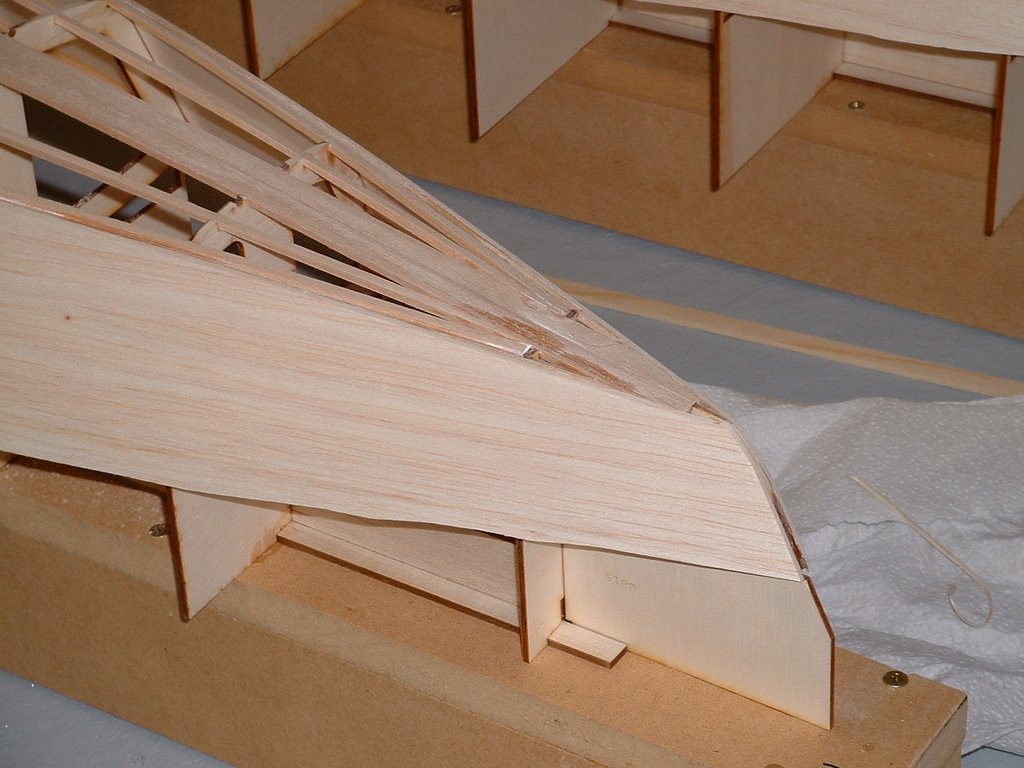
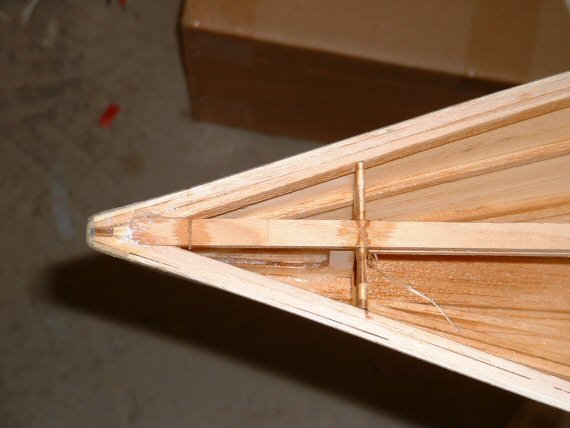
Sailing Model, AMYA Star45 Class | bow details - sides planked-- ready for bottom